Should You Incorporate as a Content Creator in Canada?
Well let’s get right into it.
The short answer is that incorporating usually starts to make sense when these two things are true:
your creator business earns meaningfully more than you need to live on, and
you're ready to run it like a real company.
The main financial benefit of incorporation is paying a lower corporate tax rate on the money you leave in the business. If you spend most of what you earn (so there's little left over after you pay yourself), incorporating mostly just adds unnecessary costs and paperwork.
If a big brand deal was delivered in Q4, or your AdSense payouts are exceeding what your 9-5 salary used to be, this question has probably been sitting in the back of your mind for a while. It's one of the biggest money decisions you'll make as a creator, and is one you need to think through fully before knowing if it’s the right move for you.
So let's walk through it the way we would with any of our clients: what incorporating changes about your business, what it costs, when it pays off and when it doesn't.
What does incorporating actually do for a creator?
When you incorporate, you create a corporation that owns your creator business. The corporation signs your brand deals, receives your platform payouts and pays your business expenses. It's a separate legal entity from you, with its own tax return and its own bank account.
That separation does two things.
It changes how your income is taxed. As a sole proprietor, every dollar of profit is added to your personal income and taxed at personal rates, which climb as you earn more. A corporation pays its own tax first. Then you pay personal tax only on what you take out of the business as a salary or as dividends.
It puts a wall between the business and your personal assets. Shareholders generally aren't responsible for the corporation's debts, but that protection has limits. If you personally sign for a business loan, you're back on the hook, and as a director for your corporation, you're personally responsible if the corporation doesn't send payroll deductions or GST/HST to the CRA. Still, it's part of why creators with bigger contracts or full-time employees tend to incorporate.
How much tax does a corporation pay in Ontario?
A Canadian-controlled private corporation (CCPC) that earns active business income (which is what most creator businesses earn) pays a much lower rate on its first $500,000 of that income each year. That $500,000 is shared with any associated corporations, like a holding company you add later. This is called the small business rate.
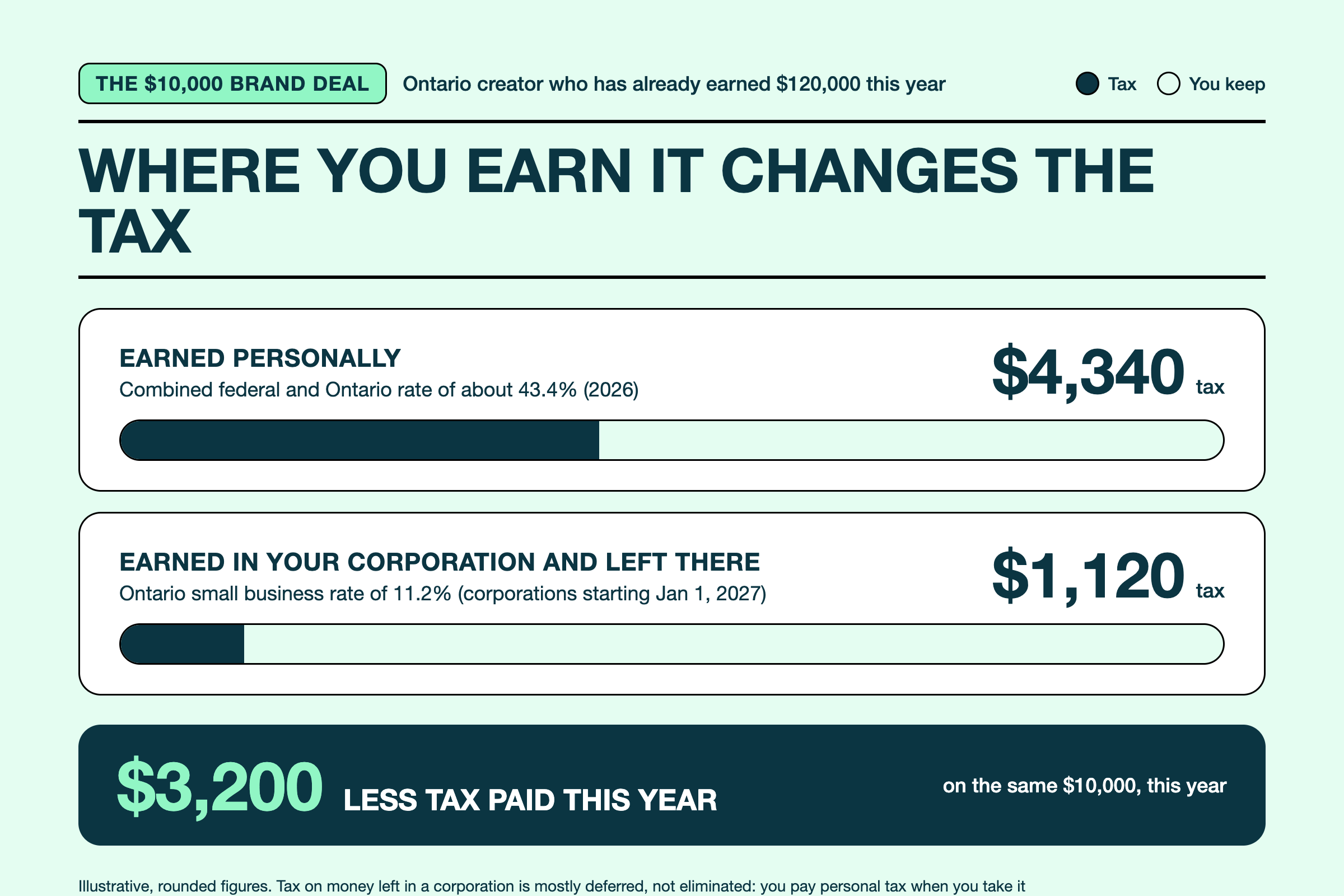
Here's what that gap looks like in dollars. Say you’ve already earned $120,000 this year and land one more $10,000 brand deal:
Earned personally: you pay about $4,340 of income tax on that $10,000 (a combined federal and Ontario rate of about 43.4% on that income in 2026).
Earned in your corporation and left there: $1,120 of corporate tax (11.2%).
That's roughly $3,200 less tax paid this year for earning and leaving that $10,000 in the business.
| Rate type | Rate on active business income |
|---|---|
| Federal small business rate | 9% |
| Ontario small business rate (from July 1, 2026) | 2.2% |
| Combined, for a corporation starting January 1, 2027 | 11.2% |
| Combined general rate (income above the $500,000 limit) | 26.5% |
Does incorporating lower your taxes?
For the most part, it just delays tax. Canada's tax system is designed so that, over time, earning money through a corporation and then paying it out to yourself costs roughly the same total tax as earning it personally. This is a concept, known by tax nerds like me, called ‘integration’. The corporation pays its low rate now, and you pay the rest when the money comes out to you as dividends or salary.
The real advantages come from the delay:
You keep more money working for you. Money you leave in the corporation has only been taxed at 11.2%, so there's more of it to invest, build a cash cushion or fund your next project.
You choose when to take it. Creator income is lumpy and sometimes unpredictable. A corporation lets you pay yourself a steady amount and leave the spikes inside, then draw more in a slower year when your personal rate is lower. That timing can lower your total tax over the long run.
If you need every dollar you make from the corporation to cover your personal expenses, leaving nothing left inside, incorporation likely doesn’t make sense for you since you'd pay close to the same amount in tax with extra costs and paperwork on top.
One Ontario note for 2027: alongside the small business rate cut, Ontario reduced its dividend tax credit on small business (non-eligible) dividends from January 1, 2027. That means slightly more personal tax when you pay yourself dividends, which keeps the total close to what you'd pay earning it personally.
An example with Earl, Canada’s next top creator:
Meet Earl, a creator based in Ontario who expects to earn $120,000 of net business income in 2027 from brand deals, AdSense and memberships, and needs about $70,000 a year to live on.
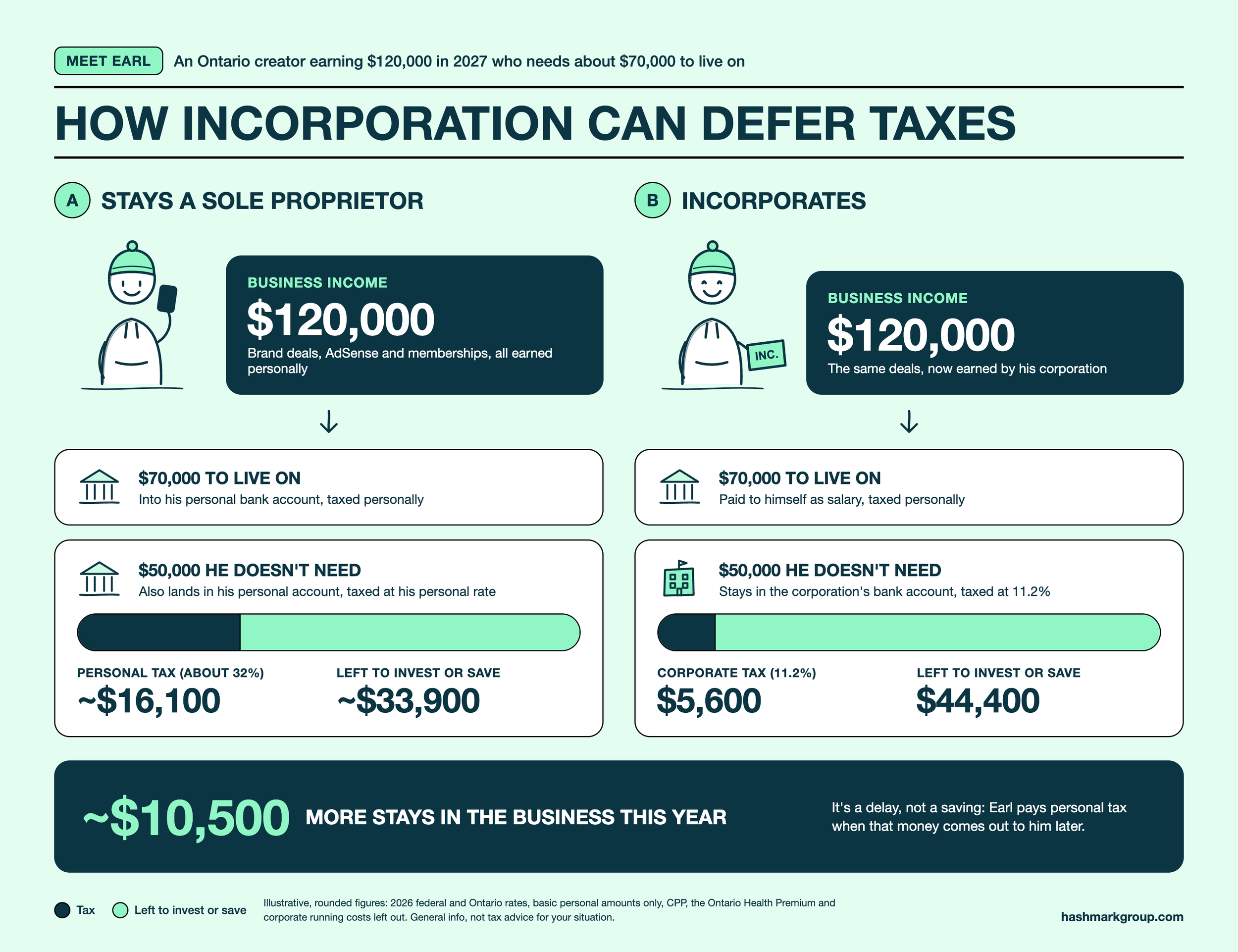
To be clear, it isn't a $10,500 saving. When that money eventually comes out to Earl as dividends or a future salary, he'll pay personal tax on it then. What he gains is the extra money working for him in the meantime and control over when that tax is paid.
Now if Earl instead spent $115,000 of the $120,000, there would be almost nothing left to leave inside the business to grow. The tax deferral benefit would be relatively insignificant, and the corporation would mostly just serve to add filing costs.
Key Assumptions Made for Earl:
Ontario resident, 2026 federal and Ontario tax rates, only the basic personal amounts claimed, CPP and other credits left out, and the corporation qualifies for the small business rate.
These are rounded estimates, not a precise tax calculation.
Earl pays himself a salary. If he took dividends instead, the corporation would pay 11.2% on the full $120,000 and less would stay inside, though his personal tax would be lower.
The table also leaves out the Ontario Health Premium and the yearly cost of running a corporation.
What are the signs it's time to incorporate?
Here's a simple checklist you can use to help think through your decision to incorporate:
You earn noticeably more than you spend. This is the big one. The potential financial benefit grows with the money you can leave in the corporation.
Your income has been strong for more than a couple good months. A couple of viral videos or one big deal isn't a pattern. A year or two of growth is.
You're signing bigger contracts. Brand partnerships with usage rights, exclusivity or a team of editors and managers bring more risk, and a corporation is the natural entity to sign them.
You’re investing more money in the business. Gear, a studio, hiring help or building a course are easier to fund with money taxed at 11.2% than at your top personal rate.
You're ready for a bit more structure. A corporation means separate books, a separate tax return and paying yourself in a more structured way.
If you checked the first item and at least one or two others, incorporation might make sense for you and is worth a deeper conversation.
Take our Incorporation Readiness Quiz to see if you might be ready to make things official and incorporate your creator business:
What does it cost to incorporate and run a corporation?
| New responsibility | Expected DIY cost |
|---|---|
| Incorporating in Ontario (government fee, online) | $300 |
| Incorporating federally (government fee, online) | $200, plus a free registration in Ontario |
| Ontario annual return (Ontario corporations) | $0, filed online within 6 months of year-end |
| Federal annual return (federal corporations) | $12, filed online within 60 days of your incorporation anniversary, along with your significant-control information |
| Corporate tax return (T2) | Required every year, even with no tax owing. Usually prepared by an accountant |
| Bookkeeping | Separate books for the corporation, kept through the year |
| Payroll (if you pay yourself or any employees a salary) | Source deduction remittances (usually monthly, sometimes quarterly) and a T4 slip by the end of February |
Professional fees for the corporate tax return, bookkeeping and payroll are usually the largest ongoing cost, and they vary with how complex your business is. Ask your accountant and your lawyer (if using one to help you incorporate) for a clear quote of these services before you incorporate so you can weigh the costs against your expected tax deferral.
What changes after you incorporate?
These are the day-to-day items that change for creators once they incorporate:
-
It also needs its own GST/HST account if it has to register. Your sole proprietor accounts don't carry over, so you'll close them once the corporation takes over. Your past sole proprietor sales can also count toward the corporation's $30,000 GST/HST threshold.
-
Every brand deal, platform payout and affiliate payment goes to the corporation's account, not yours. (If you haven't separated your money yet, our year-end tax checklist covers how.)
-
New brand deals are signed and invoiced by the corporation. Set up a new business AdSense account for the corporation and link it to your channel in YouTube Studio (approval can take a few weeks, so start in December). Update your payee details with TikTok, Patreon and your agency, and expect to complete a W-8BEN-E US tax form for the corporation.
-
Money in the corporation's account isn't yours personally until you pay it out as a salary, dividends or a mix. Salary builds RRSP room and CPP; dividends don't.
-
The corporation’s tax return is due within six months of the corporation's year-end. Any tax payment owing is generally due two months after year-end, or three months for most small CCPCs claiming the small business deduction. From the corporation's second year, you may also need to pay its tax in monthly or quarterly instalments once its tax bill tops $3,000.
-
A corporation has directors and shareholders (often just you, wearing both hats), and it has to keep corporate records, often called the minute book: its articles and bylaws, minutes or written resolutions of its directors and shareholders, a share register and a register of individuals with significant control. In a one-person corporation, the yearly approvals are usually done with signed resolutions instead of a formal meeting, and your accountant or lawyer can keep the minute book current for you. A federal corporation also has to file its significant-control information with Corporations Canada when it incorporates, every year with its annual return, and within 15 days of any change.
Gear and other assets you already own as a sole proprietor can be moved into the corporation, but how you do it has tax consequences. Plan that step with your accountant rather than just "using" your old camera in the new company.
Is January 1 a good time to incorporate?
It's a clean date and usually the one we recommend. Starting the corporation on January 1 means your 2026 sole proprietor year (which ends December 31 for most creators) wraps up as your 2027 income starts inside the corporation. One set of books ends, the next one begins, with no mid-year split to sort out at tax time.
To start fresh on January 1, 2027, aim to make the decision in November or early December. That leaves time to choose a name (and order a Nuans name report for an Ontario corporation) or use a numbered company, file the articles, open the business bank account and update your platforms before the first payout of the year.
Incorporation FAQs
-
An Ontario corporation costs $300 in government fees to set up online (plus a Nuans name report if you don't use a numbered company) and is simplest if your business is based in Ontario. A federal corporation costs $200 and gives you the right to use your name across Canada, but you'll also need to register it in Ontario (free) and in any other province where you carry on business, and most of those charge a fee.
-
Yes, you can wind up or dissolve a corporation, but it’s not a simple process. Getting the money and assets out of the business also has tax consequences, so treat incorporating as a multi-year decision rather than a one-year experiment.
-
Usually not at the start. Many creators begin with a single operating corporation and only add a holding company later, once there's a meaningful amount of savings or investments to protect.
-
Yes - but keep an eye on the total, though. Once a corporation (together with any associated corporations) earns more than $50,000 of passive investment income in a year, its federal small business limit starts shrinking the following year, and it's gone at $150,000. Ontario doesn't follow this rule, so the Ontario small business rate still applies.
-
Then talk to an accountant before incorporating. If you'd look like an employee of that brand without your corporation (if they control how, when and where you work), the CRA could treat your corporation as a personal services business. That type of income loses both lower corporate rates, faces an extra 5% federal tax and can only deduct limited expenses, so it can end up taxed more than if you hadn't incorporated. A corporation with more than five full-time employees isn't caught by this rule.
Ready to see what incorporating would mean for you?
We only work with creators.
That means your brand deals, AdSense payouts, memberships and merch aren't unusual to us because it’s what we look at every day.
We tell the story behind your numbers.
Book a call with us and we'll look at how your business earns today and what you need to live on, and tell you where you stand: whether January 1 looks like your start date, or which signal to watch for first. A rough idea of your 2026 income is all you need to bring.
This is general information and isn't tax advice for your specific situation. Tax rules change, and the right move depends on your income, province and business structure. Book a call with us or talk to another qualified tax professional before acting on it.
P.J. Carino, CPA, CA is the founder of Hashmark Group, an accounting firm for Canadian content creators. Before founding the firm, he left a Big 4 firm to run his YouTube channel, TDI Hockey, full-time.
Sources: